THE SCENE
What a mes: Why JLaw’s Biotech Haircare Line Doesn’t Justify the Price Tag
Backed by serious lab credentials, the Oscar winner’s new venture promises effortless cool-girl hair—but early testers and the ingredient lists tell a very different story.
On this page
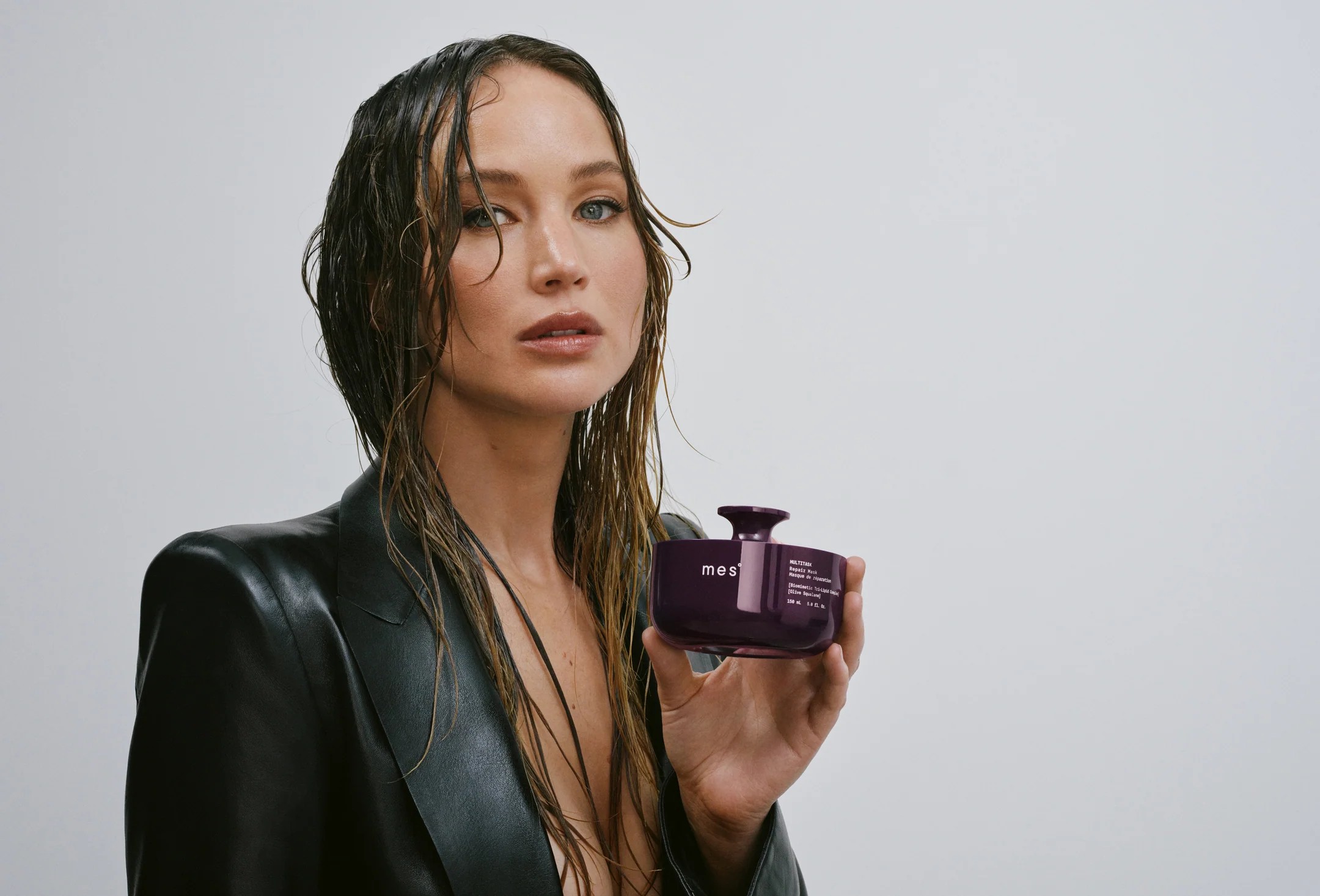
When an A-list actor pivots to beauty, industry veterans brace for the inevitable marketing bingo: “I couldn’t find what I was looking for on set, so I made it myself.” With the launch of mes°, Jennifer Lawrence leans into her signature self-deprecating charm, pitching a three-product capsule ($34 to $52) designed for "low-maintenance" routines.
To be fair, mes° didn’t just slap a celebrity name onto a generic white-label catalog. The brand was incubated for three years alongside Arcaea, a Boston-based beauty biotechnology company spun out of synthetic biology giant Ginkgo Bioworks. Led by MIT-trained engineer Jasmina Aganovic and backed by $78 million in Series A funding from heavyweights like Chanel, Givaudan, and Olaplex, Arcaea serves as both the financial backer and scientific developer behind mes°. Their mission? Using precision fermentation and bio-designed polymers to create proprietary cosmetic ingredients.
On paper, that pedigree separates mes° from a typical celebrity cash grab. In practice, however, once you strip away the trademarked biotech buzzwords, the actual ingredient profiles fail to justify the luxury price tag.
Take the hero Multitask Repair Mask ($52), formulated for dry hair as a pre-shampoo treatment or post-wash leave-in. It touts a "Biomimetic Tri-Lipid Complex" and Polycitronellol—a biobased polymer meant to mimic the slip of silicones without buildup. Yet the formula relies heavily on standard olive squalane and coconut oil. Similarly, the Off-Duty Restyling Serum ($44) highlights "AirSilk™ C15-19" alongside vegan keratin and flaxseed. Anyone fluent in cosmetic chemistry knows C15-19 Alkane is a widely available, plant-derived volatile emollient already found in countless $15 drugstore formulas.
In short: the "innovation" here isn’t a leap forward in hair repair. It’s green-chemistry silicone alternatives dressed up in expensive biotech jargon. And as any formulation purist knows, replacing reliable silicones with plant alkanes and basic lipids rarely delivers superior frizz control or slip.
Early real-world feedback is already proving how rocky that trade-off can be. Certified trichologist and haircare creator Abbey Yung (@abbeyyung) recently shared her first impressions after receiving the PR box—and she didn’t hold back. Despite loving pre-shampoo treatments, Yung called the $52 mask "a fail across the board," faulting everything "from the texture, to the way it smells, to how it feels to apply, to what happened to my hair in the shower after using it," before concluding, "It’s not something I’d ever spend $52 on myself."
The comment section quickly turned into a collective reality check for the launch:
- The Texture: Board-certified dermatologists Doctorly (@doctorly) chimed in on the mask’s bizarre consistency, noting, "Tried the mask yesterday - it reminded me of hair gel I used to use in high school."
- The Scent: When a follower recalled Lawrence joking that her husband thought the mask smelled fishy, Yung confirmed: "It 100% smells fishy!!! It was my first thought." Fellow creator Sally Lyndley (@sallylyndley) noted the conflicting fragrance profile and lackluster performance: "I hate the very heavy cologne smell and I feel like the mask dried my hair out and the serum made my hair even more frizzy."
- The Positioning: Everyday consumers questioned the premise entirely, pointing out that silicones actually work, the campaign hair looked underwhelming, and—as one top comment put it—"I’ve never looked at her and thought ‘oh I wonder what she does for her hair to look like that."
Biotechnology has a thrilling future in beauty, and Arcaea clearly has serious lab power at its disposal. Unfortunately, mes° feels like a disconnect between high-concept lab marketing and everyday hair performance. When a $52 mask leaves hair feeling dry, smells questionable, and relies on basic lipids and silicone substitutes that get outperformed by a jar of drugstore Dove, it isn't elevated, it's just overpriced.