
BEAUTY
The Sound of Glass Skin: Decoding LDM Ultrasound Technology
How high-frequency sound waves became K-beauty’s favorite zero-trauma secret for bouncy skin—and whether an at-home device can truly rival a clinical session.
On this page
For years, the golden rule of anti-aging skincare was simple: no pain, no gain. If a treatment didn’t burn, zap, peel, or needle your face into a state of controlled panic, was it even doing anything?
Enter LDM (Local Dynamic Micro-Massage)—the German-engineered, Seoul-perfected ultrasound technology that threw the "controlled trauma" playbook out the window. If you have ever wondered how K-beauty insiders maintain that bouncy, lit-from-within "water drop" glow without looking over-treated or inflamed, LDM is the quiet powerhouse behind the curtain.
Now that this clinical technology has officially migrated onto our bathroom vanities—through sleek tools like the Thome The Glow and the Quadthera Titan—it is time to break down what LDM actually does, separate the "skin tightening" marketing hype from biological reality, and see how an at-home wand stacks up against a dermatologist’s chair.
What Exactly Is LDM Technology?
At its core, LDM uses rapidly alternating ultrasound waves to create a cellular "micro-massage" within the skin. Unlike traditional single-frequency ultrasound, LDM oscillates between two or more frequencies—switching back and forth up to 100 to 1,000 times per second.
This rapid alternation creates gentle mechanical pressure gradients in the tissue, triggering three game-changing biological responses:
- Silencing Inflammation (The MMP Reset): Aging and acne-prone skin have an overabundance of Matrix Metalloproteinases (MMPs)—destructive enzymes that chew up your existing collagen and keep skin in a cycle of redness and breakouts. LDM downregulates these enzymes, hitting the brakes on collagen breakdown and soothing conditions like rosacea, eczema, and perioral dermatitis.
- Waking Up Cellular Defense (Heat Shock Proteins): Without generating damaging thermal heat, the ultrasonic vibrations stimulate Heat Shock Proteins (HSPs). Think of HSPs as your skin’s quality-control managers: they strengthen cellular immunity, repair damaged proteins, and wake up dormant fibroblasts.
- Redistributing Hydration (GAGs & Hyaluronic Acid): LDM unclusters stagnant water molecules and stimulates Glycosaminoglycans (GAGs) in the dermis. It pulls bound water upward, creating an immediate plumping, dewy effect that topical serums alone cannot mimic.
The Crucial Distinction: LDM is Not HIFU (Your Facial Fat is Safe)
Wait—if ultrasound reaches deep into the skin, can it melt facial fat like Ultherapy (HIFU)? No.
HIFU focuses low-frequency beams into intense thermal coagulation points deep in the SMAS layer. LDM is unfocused and non-thermal. It physically cannot melt lipid cells.
Instead, LDM relies on the synergy between lower and higher frequencies. In ultrasound physics, the lower the frequency (Megahertz, or MHz), the deeper the wave travels; the higher the frequency, the shallower it stays:
- 1MHz (~3cm depth) & 3MHz (~1cm depth) — The Deep Collagen & Contouring Engines: These are your deep-acting anti-aging workhorses. The 1MHz wave promotes deep microcirculation and lymphatic drainage, sweeping away puffiness and swelling along the jawline. Meanwhile, the 3MHz wave lands squarely in the deep dermis, where your structural fibroblasts live—making it the primary driver for collagen and elastin synthesis.
- 10MHz (~3mm depth) & 17–19MHz (~1.5mm depth) — The Barrier & "Glass Skin" Polishers: These ultra-shallow waves concentrate all their mechanical energy right in the upper dermis and superficial epidermis. They calm surface redness, compact a leaky skin barrier, smooth out crepey texture, and create that unmistakable surface glow.
The magic of LDM isn't choosing one frequency over the other—it is the rapid oscillation between them. A 3MHz/10MHz dual wave (or a 1/3/10/17MHz quad wave) simultaneously stimulates deep dermal collagen with the lower frequency while repairing the surface barrier with the higher frequency.
In-Office vs. At-Home LDM: What Is the Difference?
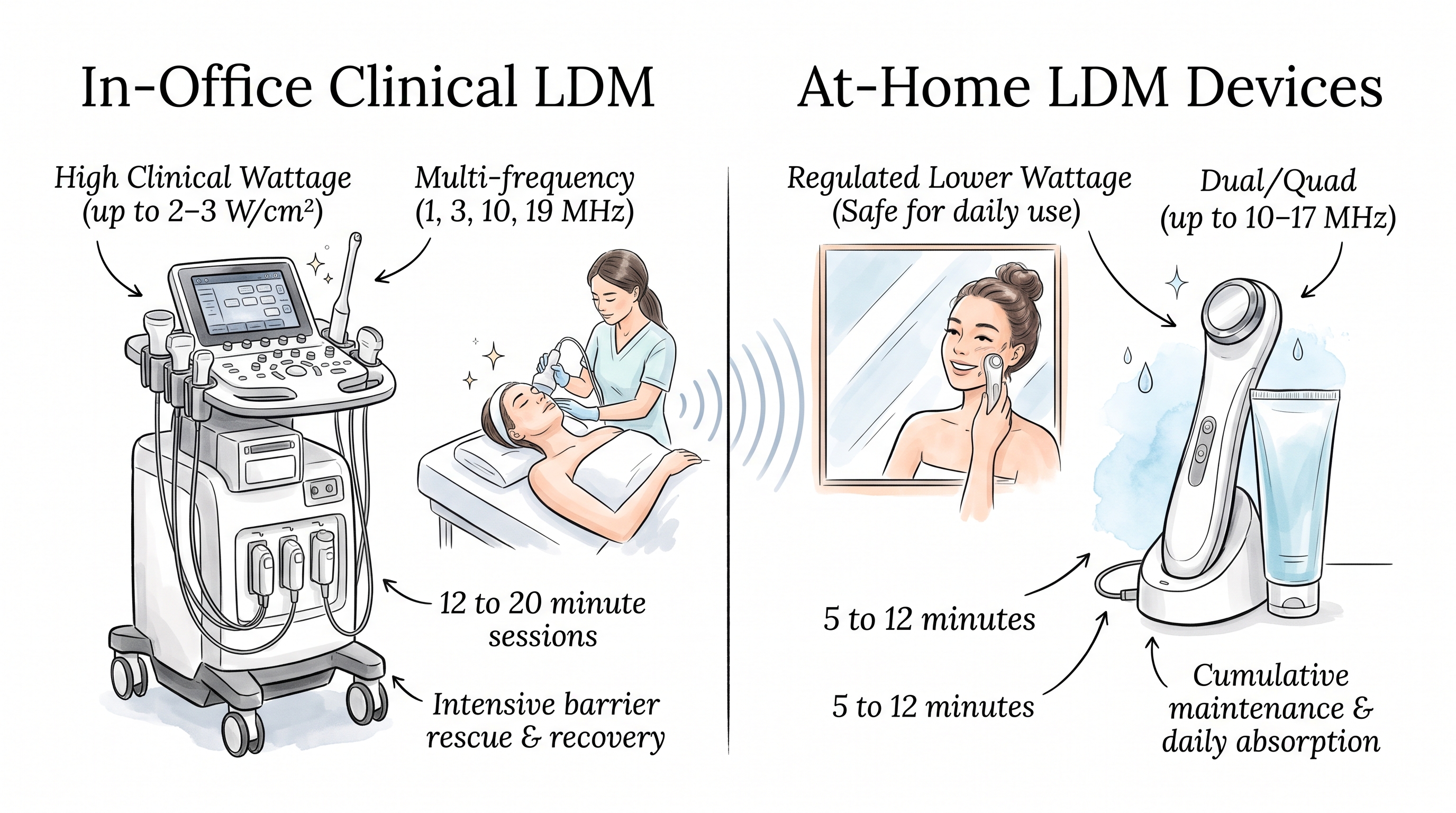
While both clinical machines (like the gold-standard Wellcomet LDM-MED or LDM Triple) and at-home handhelds share the same foundational physics, they are engineered for different roles in your routine.
| Feature | In-Office Clinical LDM | At-Home LDM Devices |
|---|---|---|
| Frequency Range | 1MHz, 3MHz, 10MHz, and 19MHz (Triple/Quadruple wave oscillation) | Typically, Dual or Quad (1MHz/3MHz/10MHz/17MHz, or focused 3MHz/10MHz) |
| Energy Output | High clinical wattage (up to 2–3 W/cm²) for rapid cellular stimulation | Regulated lower wattage for safe, unsupervised daily or weekly use |
| Treatment Time | 12 to 20 minutes (Paired with clinical ampoules or post-laser recovery) | 5 to 12 minutes (Designed for quick, consistent habit-stacking) |
| Primary Strength | Intensive barrier rescue, halting active flares, immediate event-ready plumping | Cumulative maintenance, daily product absorption, keeping inflammation at bay |
| Cost Structure | $150 – $350+ per session (Usually recommended in packages of 6–10) | $180 – $900+ one-time investment depending on the device tier |
Peak Power vs. Cumulative Consistency
An in-office LDM machine packs significantly higher acoustic intensity and switches frequencies with medical-grade speed. One 20-minute clinic session after a harsh laser or microneedling treatment will visibly calm erythema on the spot.
However, LDM is fundamentally a cellular conditioning therapy. Much like red light therapy or microcurrent, your MMP enzymes and hydration channels respond best to frequent, gentle nudges rather than a single monthly blast. Using a well-formulated at-home 3MHz/10MHz device three to four times a week builds a resilient, hydrated skin barrier that an occasional spa visit cannot sustain on its own.
Marketing Reality Check: Does LDM Actually "Tighten" Skin and Build Collagen?
Because "skin tightening" is the ultimate viral buzzword in beauty tech right now, many brands market at-home LDM wands as instant lifting and tightening miracles. Let’s set the record straight: LDM is a skin-density and plumping technology, not a thermal tissue-shrinker.
When you use thermal Radiofrequency (RF) or HIFU, you are heating the tissue to shrink collagen fibers on impact and trigger a wound-healing cascade. LDM doesn’t use destructive heat, so it will not physically shrink sagging jowls or replace a surgical lift.
However, LDM absolutely builds and preserves collagen—it just takes a gentler backdoor route:
- Stopping the Leak: By suppressing destructive MMP enzymes, LDM stops your skin from breaking down the collagen it already has.
- Mechanotransduction (Mechanical Fibroblast Stimulation): Fibroblasts—the cells that manufacture collagen and elastin—respond to physical movement. When LDM’s alternating sound waves rapidly vibrate the dermis, they gently tug on the cell membranes, signaling lazy fibroblasts to wake up and synthesize fresh collagen and elastin.
- Turgor and Lymphatic De-Puffing: Much of the "lifted, tighter" look people rave about after an LDM session comes from two things: lymphatic drainage (clearing out heavy, stagnant fluid that weighs down your lower face) and dermal turgor (flooding the extracellular matrix with hyaluronic acid so the skin snaps back like a fresh, hydrated sponge).
In short? Expect firmer bounce, refined pores, softer fine lines, and a denser, more resilient cushion—not a harsh, shrink-wrapped pull.
The Editorial Verdict
You do not need an in-office appointment to experience the barrier-strengthening magic of LDM. If you are dealing with an acute flare-up, prepping for a major event, or healing from an aggressive clinical laser, an in-office LDM Triple session is worth every penny.
But for the everyday pursuit of calm, bouncy, resilient skin —especially if you use active retinoids or prescription acids— an at-home multi-frequency LDM device (one that pairs deep-acting 1MHz or 3MHz with barrier-polishing 10MHz+) is one of the smartest, zero-downtime investments you can make. It won't give you a thermal facelift—and it shouldn't claim to. What it will give you is healthy, high-density skin that ages in slow motion. Elevated results, zero trauma required.