
ON THE RADAR
The Exosome Dilemma: Are the "Billions of Vesicles" in Your Serum Even Alive?
Exosomes are the biggest biotech story in regenerative skincare—if they actually survive the trip from the lab to your vanity.
On this page
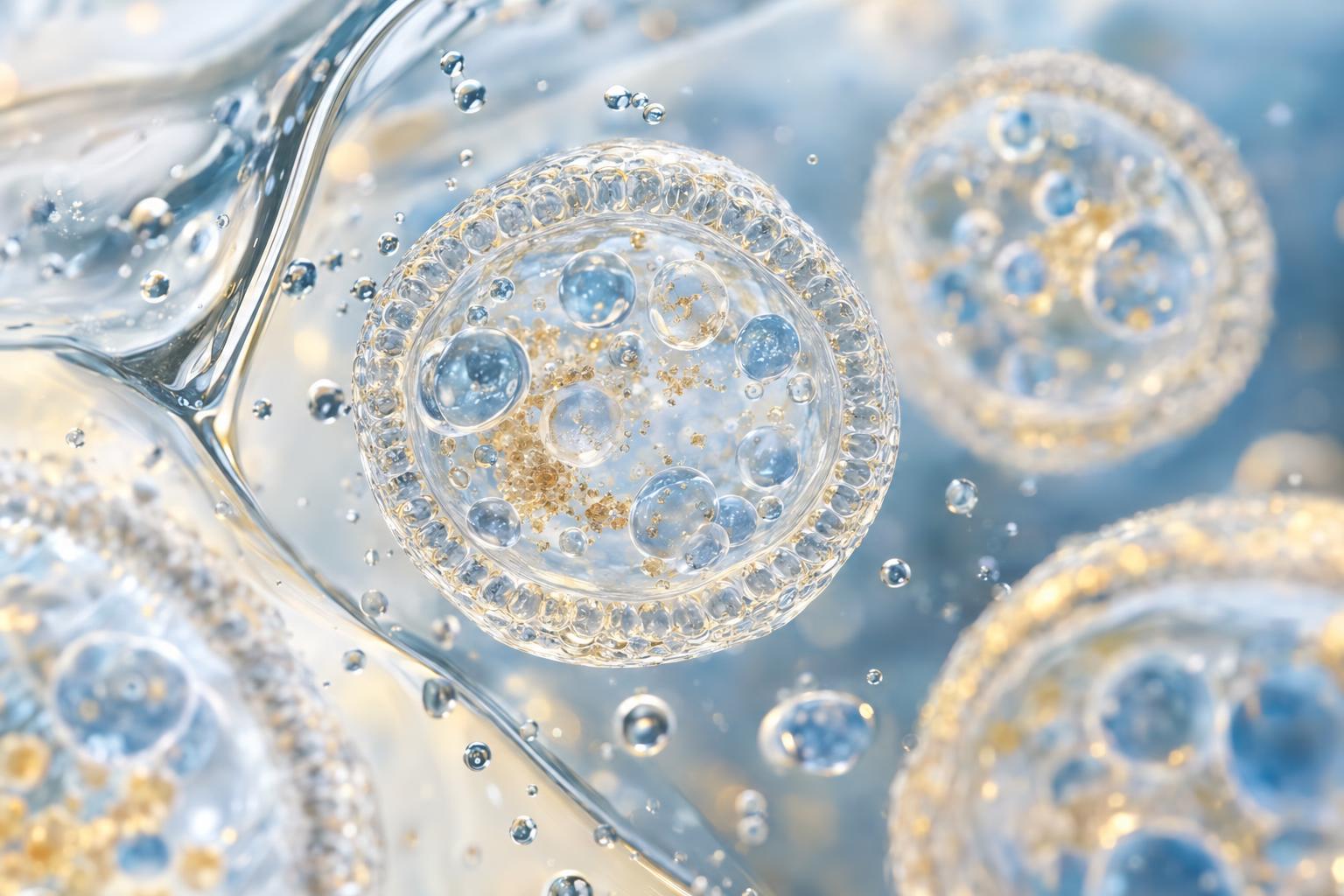
Walk into any high-end Med Spa—or scroll through the latest K-beauty launches—and one word dominates the conversation: exosomes. Touted as the next frontier beyond peptides and stem cell extracts, exosomes are extracellular nano-vesicles (30 to 150 nanometers in diameter) naturally secreted by cells to communicate with one another.
Instead of acting as a single ingredient, an intact exosome is a microscopic biological "care package." Wrapped in a protective lipid bilayer, it ferries a complex payload of signaling peptides, growth factors, lipids, and microRNA (miRNA) directly to recipient skin cells, instructing sluggish fibroblasts to ramp up collagen synthesis, calm inflammation, and accelerate barrier recovery.
In controlled clinical settings, the data is compelling. A 2024 review in Biomaterials Research (PMC10785444) found that stem cell-derived exosomes don't just boost new collagen and elastin, they also hit the brakes on the enzymes that break down your skin's structural matrix. Similarly, a randomized split-face clinical trial published in the Journal of Cosmetic Dermatology (Park et al., 2023) demonstrated that pairing microneedling with human stem cell exosomes improved skin elasticity, hydration, and wrinkle depth far more than microneedling on its own.
So why are cosmetic chemists and dermatologists raising an eyebrow at the explosion of $50 to $300 over-the-counter exosome serums?
The Dirty Secret of Exosome Skincare: Vesicle Collapse
In a laboratory, native biological exosomes are notoriously fragile. To keep their phospholipid membranes intact and their RNA/protein cargo biologically active, medical-grade exosomes typically require ultra-cold storage (-80°C) or immediate use after reconstitution.
When you put an unstabilized exosome into a standard water-based cosmetic serum, it faces a brutal gauntlet before it ever touches your face:
- Manufacturing Shear Stress: Traditional cosmetic emulsification uses high-speed homogenization and heat (often exceeding 70°C). Both forces physically shred delicate exosomal lipid bilayers during production.
- Surfactant & Preservative Lysis: Standard cosmetic preservatives, glycols, and emulsifiers are designed to disrupt microbial cell membranes—meaning they also dissolve the lipid envelope of exosomes on contact.
- Distribution & Thermal Degradation: Research on extracellular vesicle stability (Journal of Extracellular Vesicles) shows that stored in liquid at room temperature—let alone inside a hot delivery truck or warehouse—native exosomes suffer rapid vesicle collapse, aggregation, and RNA degradation within days to weeks.
In short: when a mass-market brand claims "10 billion exosomes" in a watery dropper bottle sitting on a warm retail shelf, there is a high probability those fragile bubbles have already burst, leaving behind a broth of broken proteins and lipids that hydrate the surface of your skin, but can no longer signal your cells.
Human, Plant, or Synthetic: What Is Actually Inside the Bottle?
Because the EU, UK, and South Korea ban human-derived cells in cosmetics and the US FDA strictly scrutinizes biological claims—the market has split into three distinct tiers:
- Stabilized Human-Derived Exosomes (US Medical-Grade): Brands like (plated) Skin Science use human platelet-derived exosomes processed with patented stabilization technologies (Renewosome lyophilization/antioxidant matrix) specifically engineered and tested to remain intact at room temperature.
- Lyophilized (Freeze-Dried) Two-Part Systems: In clinics and serious K-beauty protocols, true exosomes are often sold as a freeze-dried powder vial that you mix with a sterile diluent right before application, bypassing shelf-life degradation in water.
- Plant-Derived Extracellular Vesicles (PDEVs) & Biomimetic Exosomes: Many everyday serums use vesicles extracted from Centella asiatica, rose, or panax ginseng. While plant vesicles contain soothing antioxidants, human skin cells do not have the exact same lock-and-key surface receptors for plant RNA. Unless cold-processed below 25°C at a strict 6.0–7.0 pH, plant vesicles suffer the exact same membrane collapse in water.
How to Shop Exosomes Without Getting Burned
Before investing in an exosome serum, look past the "billions of vesicles" marketing claim and ask how the formula survives the supply chain:
- Look for Stabilization Proof: Seek out lyophilized (freeze-dried) chambers, waterless suspension matrices, or patented room-temperature stabilization data backed by Transmission Electron Microscopy (TEM) proving the vesicles remain intact at 6 to 12 months.
- Demand Airless, Opaque Packaging: Clear glass dropper bottles expose fragile exosomal phospholipids to light and oxygen, accelerating membrane rupture.
- Pair With Barrier-Friendly Delivery: Intact exosomes penetrate best when the barrier is prepped—making them ideal post-treatment companions for high-frequency LDM devices.